Städtebau agiert im Spannungsfeld zwischen selbstgenerierenden Prozessen und der Steuerung durch Planung und Gestaltung. Als Mittler und Mitgestalter können Archietkt*innen vielfältige Rollen einnehmen.
Die Vorlesungsreihe stellt historische und aktuelle Tendenzen des internationalen Städtebaus vor.
Es werden die Prozesse beschrieben, die urbaner Entwicklung zu Grunde liegen, und Methoden und Werkzeuge für Analyse, Entwurf und die Gestaltung von Stadtentwicklungsprozessen an Beispielen erläutert.
Besondere thematische Schwerpunkte sind Globalisierung, Klimawandel, Digitalisierung, Akteur-Netzwerke, Typologie und Morphologie, Ko-produktion und urbane Regelwerke.
Die Vorlesungsreihe wird gemeinsam von den Fachgebieten SU, CUD, HU und CUE bestritten und begleitet den städtebaulichen Entwurf im 3. Semester.
Die Vorlesungsreihe Städtebau ist eine Einführung in das städtebauliche Entwerfen und begleitet das Entwurfssemester Städtebau im 3. Semester Bachelor. In der Vorlesungsreihe werden aktuelle internationale Tendenzen der Stadtentwicklung, Grundbegriffe und Werkzeuge des städtebaulichen Entwerfens sowie die technischen Grundlagen vermittelt. Darüber hinaus werden die verschiedenen Aufgabenfelder und Entwurfswerkzeuge der Städtebauer*in bzw. des urban practicioners an praktischen Fallbeispielen erläutert.
Vorlesungen 1-3: Grundlagen
Vorlesungen 4-7: Werkzeuge
Vorlesungen 7-10: Fallstudien
Vorlesungen 11-12: Urbanistische Spekulationen (Forschung)
16.10.26 – 1. Urbanisierung & Globalisierung / Hagemann
23.10.26 – 2. Stadtökologie: Theorie & Ethik / Vialle
30.10.26 – 3. ANT – Akteure, Netzwerke & Koproduktion / Stollmann
06.11.26 – 4. Stadtökologische Analyse & Mapping / Vialle
13.11.26 – 5. Städtebauliche Analyse / Hagemann
20.11.26 – vorlesungsfrei / Bauaufnahme-Woche Bachelor Architektur
27.11.26 – 6. Typologie & Morphologie: Berlin & Paris / Stollmann
04.12.26 – 7. Grand Urban Rules & Planungsinstrumente / Stollmann
11.12.26 – 8. Auf dem Weg zu einem bodenregenerativen Urbanismus / Vialle
18.12.26 – vorlesungsfrei / Jahresendschließung
26.12.26 – vorlesungsfrei / Jahresendschließung
01.01.27 – vorlesungsfrei / Jahresendschließung
07.01.27 – Rückmeldung der Studierenden (ILaUP) über Gruppengröße (max. 6 Pers.), ggf. Zuteilung durch uns
08.01.27 – 9. Suburbia, Smart Cities & Enklaven / Stollmann
15.01.27 – 10. Regenerative Quartiere / Misselwitz
22.01.27 – 11. Territorial Speculations from the Atlantic Forest to the Cryosphere / Goldinger & Zalis
28.01.27 – Rückmeldung der Studierenden (ILAuP) zum Thema Poster
29.01.27 – 12. Raum, Ort und alltägliches urbanes Erbe / Lacour
29.01.27 – Bekanntgabe der Gruppenzuordnungen und Abgabemodalitäten (ILaUP)
05.02.27 – 13. Pecha Kucha: 1-Slide Präsentation der Themen durch die Studierenden ILaUP / alle FG
12.02.27 – vorlesungsfrei / Schlusspräsentationen Studios
12.03.27 – Posterabgabe (nicht BSc Arch)
Abgabe Skizzenbuch (BSc Arch) mit der Abgabe des Entwurfes in den zwei Studios
Für Studierende des BSc Architektur wird die Vorlesung mit einem Skizzenbuch als Dokumentation der Vorlesungsinhalte geprüft. Für die BSc Landschaftsarchitektur und BSc Ökologie und Umweltplanung, sowie die MSc Landschaftsarchitekturund MSc Environmental Planing ist die Abgabeleistung ein A1 Poster.
Vorlesungszeit 16.10.2026 – 05.02.2027
Vorlesung Freitags 9:00 – 10:30, A815
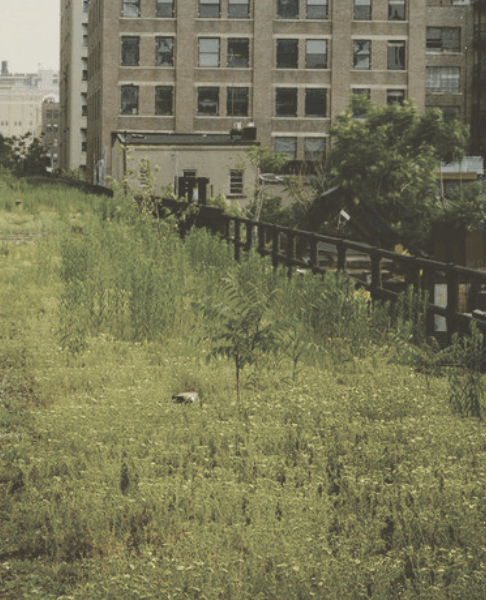
(fig: Highline New York vor dem Bau des High Line Parks, Joel Sternfeld, www.thehighline.org)