Mapping Through the Looking Glass
Seminar SS26
Teaching
Berlin is widely regarded as one of the queer capitals of the world. Maps produced by the City of Berlin or by Siegessäule reinforce this claim through the marking of the city’s milestones. These spatial representations of queerness are largely oriented toward the tourism industry and function as a form of urban branding that caters to market demands. As such, they often carry ambiguous political meanings for queerness, serving neoliberal regimes of spatial production while reinforcing forms of homonormativity. Queerness today can be understood through tensions between the “neoliberal queers” of the present and the radical queer movements of the past. These positions frequently exist in conflict and contradiction rather than within a single coherent queer space. Such fractures can already be observed in Berlin itself: in the existence of two pride parades, in the contrasts between lesbian and gay housing projects, and in the spatial tensions between queer centers and anti-queer peripheries.
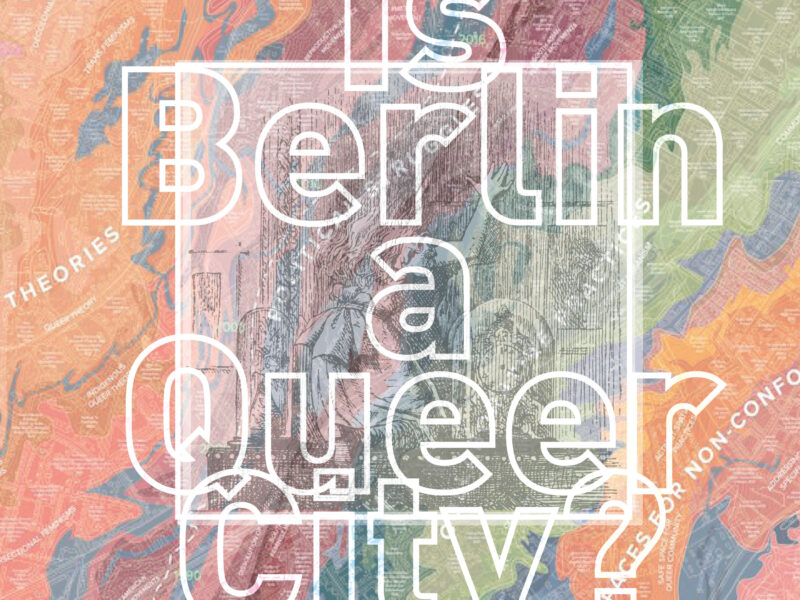
This seminar aims to address the complexities of queer representation in a more conflictual yet intersectional manner. Its objective is to investigate how urban domains such as housing, leisure, labor, public space, nature, culture, and infrastructures of care might be presented as queer counterparts to normative spatial orders, and to examine the spatial and systemic forces that enable or constrain these processes. In this sense, the seminar employs research methods and various forms of mapping in order to produce a publication that questions the dominant narratives often reproduced by existing “queer maps” of Berlin and instead asks a broader question: Is Berlin a queer city?
Team: Prof. Jörg Stollmann, Veljko Marković
(fig: Collage: Moschinos ‚Baustellen-chic‘ in Berlin-Steglitz)